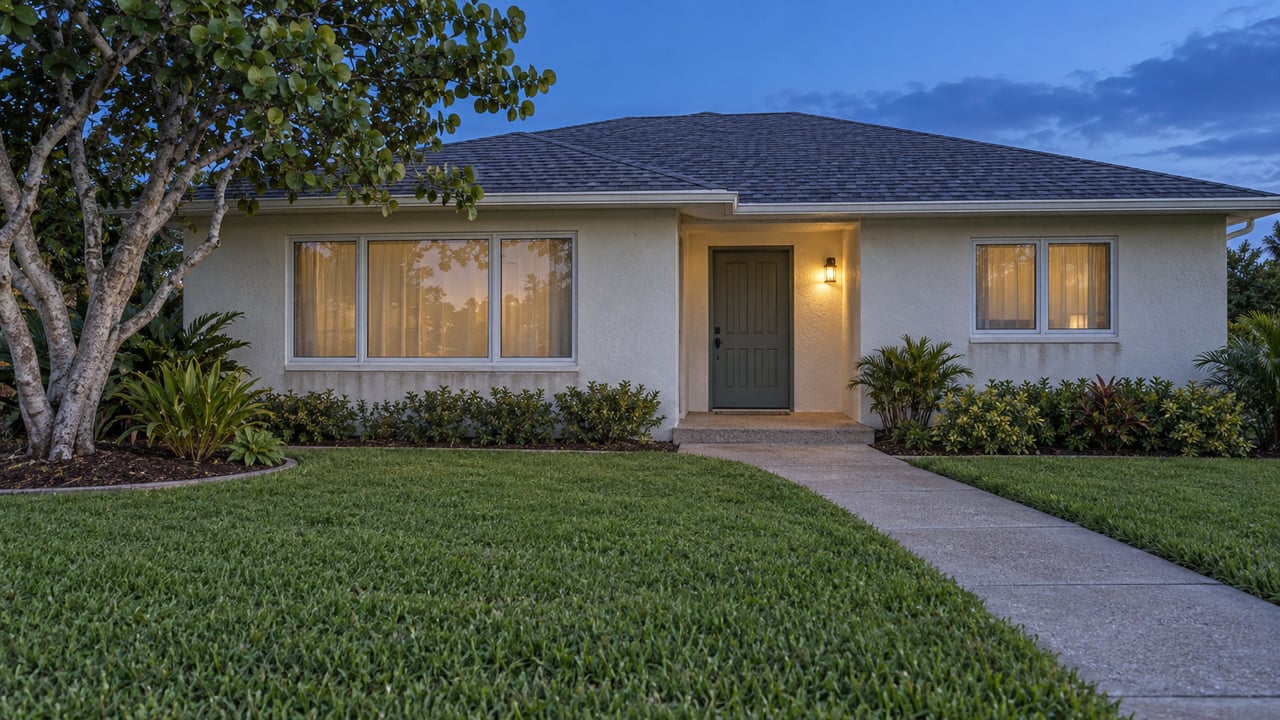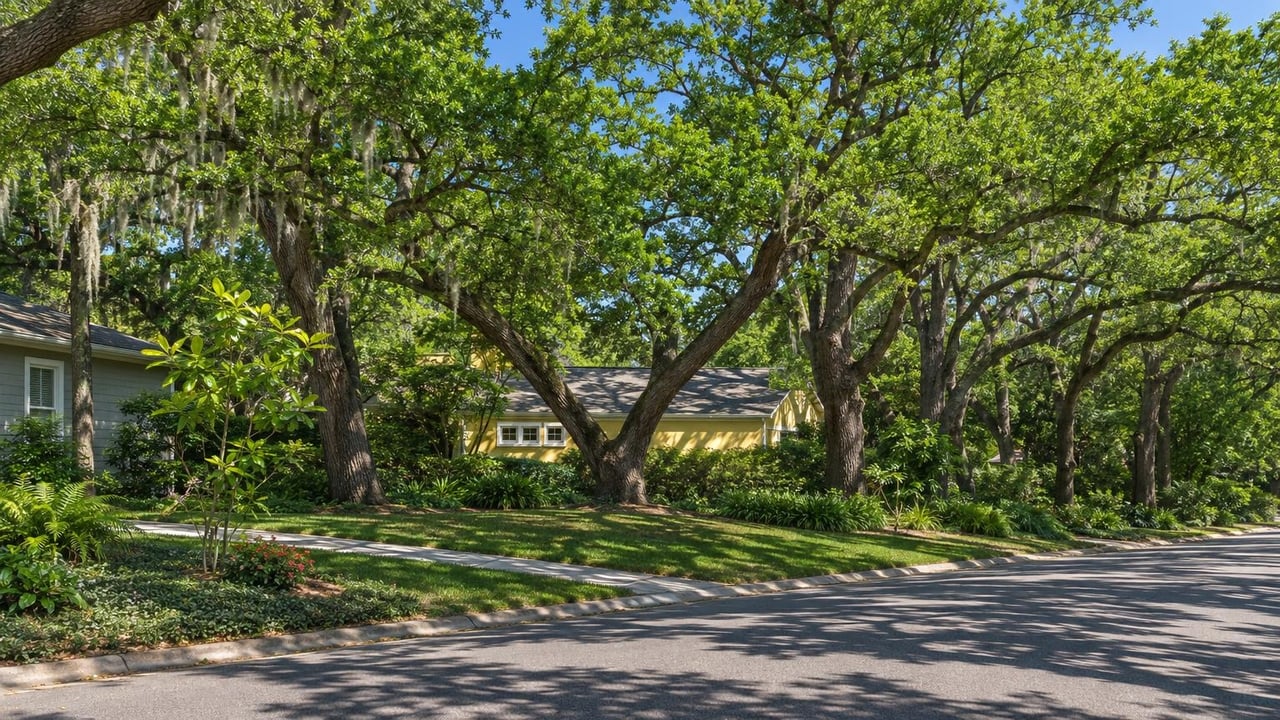
In January 2025, a house at 3611 8th Street North in Allendale Terrace sold for its full asking price of $1.01 million after 42 days on the market. It faces the three-acre Allendale Park across an Augusta red brick street, and inside it still has its original oak floors and a dining room with Spanish Mission tile, according to the St. Pete Catalyst's sale report. It was built in 1953.
The usual picture of Allendale Terrace is the 1920s: stone veneer, Mission-style arches, houses built by the developer himself. Those houses are real and they're worth seeing. They are also a minority. Most homes in Allendale Terrace went up after World War II, and a buyer weighing it against Crescent Heights or Historic Old Northeast is mostly choosing among postwar houses that sit on a 1923 street plan. That changes how you should read a price here.
The street plan is older than most of the houses
Cade B. Allen was a brick mason from New York who came to St. Petersburg in 1912. Before he built houses he ran a truck garden and a dairy around Crescent Lake, and his cattle grazed on what is now Miller Huggins Field. In December 1922, Allen and developer Harold Smith bought 135 acres known as "The Foster Grove" from the estate of W.L. Foster. Allen's son Donald believed the price was $186,000. All of this comes from a neighborhood history by Jack Spinrad, published in Green Bench Monthly in 2017 and reprinted by the Allendale association.
The partners hired George F. Young Civil & Landscape Engineers to lay out the streets and blocks. The plat for Allendale Park was recorded on April 4, 1923, and brick streets with granite curbs followed. The same history counts 74 homes built before World War II, 186 built between the war and 1960, and 50 built after that, as of 2017. Out of roughly 310 houses, about six in ten date from the postwar years and about one in four from before the war.
The streets, the blocks and the brick paving date to 1923. Most of the houses came later and filled in that plan, so a 1950s house can sit on the same brick block as a 1920s one.
The city's Allendale Terrace association map, dated April 2026, matches the boundaries in the history: 34th to 42nd Avenue North between 7th Street North and Dr. Martin Luther King Jr. Street North, plus 34th to 38th Avenue North from MLK west to Haines Road, with Allendale Park inside. The 2017 history also notes that the neighborhood has no apartments or stores within those boundaries.
Forty houses carry the reputation, and they span three decades
Between 1922 and 1954, Allen and his sons built 40 houses in Allendale. All of them have hollow clay tile walls, and many have a stone veneer. Some use local coquina. Others use granite, sandstone and fieldstone brought in by rail from Georgia, Alabama, North Carolina and Tennessee.
You can trace the family's own homes on a walk:
- The "Snow House" at 3405 9th Street North, which the family lived in from 1924 to 1925.
- The gray granite house completed in 1925, originally 3600 9th Street North and now addressed as 3601 Foster Hill Drive North.
- 944 39th Avenue North, a large Spanish-style masonry house from 1928, where the family lived until 1947.
- 945 40th Avenue North, built in 1939 and sold to a William Garrison. The Allens bought it back in 1950.
- 1020 41st Avenue North, built in 1954 of pink and white marble from Georgia, the last house Allen designed and built as Cade B. Allen & Sons.
The gray granite house at Foster Hill Drive and MLK is known as "the Castle." The Tampa Bay Times reported its restoration in 2014 and described it as a 1925 stone Mission-style house. A few blocks south, the Almon Jones–Jay Black House at 3624 Dr. MLK Jr. Street North was built by Allen around 1928. The city designated it a local landmark in 2004, according to a city staff report.
The Allen houses don't come from a single era. Two of the five family homes on that list were built in 1939 and 1954. When a listing calls a house "Allen-built," you know who built it and with what materials, and the year still has to be checked. St. Petersburg's historic design guidelines date Mission Revival's Florida popularity to the 1910s and 1920s and include an Allendale example. The same guidelines describe the ranch house as dominant in the 1950s and 1960s, the decade when much of the rest of the neighborhood was built.
What a 1953 house on the park sold for
Back to 3611 8th Street North. The Catalyst report describes a two-story house with 3,190 heated square feet on a 0.17-acre lot. The 2,440-square-foot main level holds the living room, the dining room, an updated kitchen, two guest rooms and an exercise room. The primary bedroom sits in a 750-square-foot second-floor addition completed in 2003. The house had last sold in 1991 for $85,000.
The $1.01 million price works out to about $317 per heated square foot. That figure mixes two construction dates: a 1953 core and an addition from 50 years later. The house is postwar, and it has no Allen-family stone veneer in that report. It still sold at full asking price in 42 days, and the features the report chose to describe were the brick street, the park across the road and the original floors. The brick street dates to the 1923 plan, and the floors survived because of how the house was kept.
At $1.01 million, this 1953 house sold well above the $450,000 Pinellas County single-family median for October 2026, even though the two figures are almost two years apart. A postwar house on one of Allendale Terrace's brick blocks facing the park still sells as an Allendale Terrace house.
Reading that sale against the county in late 2026
That sale closed in January 2025, so it's a dated data point. The current backdrop comes from the Pinellas REALTOR Organization's October 2026 report, released November 16. In October 2026, Pinellas County had 741 closed single-family sales, down 16.1% from October 2025, and the median sale price held at $450,000, unchanged from a year earlier. The median time to contract that month was 39 days, down 15.2% year over year. Months of supply was 3.9 and active listings were 3,245, down 11.2% from October 2025.
Countywide, prices are flat, fewer homes are selling, and the homes that do sell are going under contract somewhat faster than a year ago. In that market, a buyer or seller in a neighborhood of about 310 homes works from very few local sales. Each comparable carries a lot of weight, and choosing the wrong one moves the number a long way. Comparing a 1953 house with a 1925 stone house only because both say "Allendale Terrace" in the listing puts two different kinds of building on the same scale.
How I match comparables inside Allendale Terrace
My appraisal work runs on a simple rule: compare like with like, and here that means sorting by era before sorting by address. I'd weigh an Allendale Terrace house in this order:
- Construction era and method. An Allen-family house with hollow clay tile and stone veneer is its own group. A house built between the war and 1960 is compared with other postwar houses, and the roughly 50 homes built after 1960 form a third group.
- Additions, dated separately. A house like 3611 8th Street North has a 1953 core and a 2003 second floor. Each part's square footage and finish get their own adjustment instead of one blended "year built."
- Frontage. A lot facing Allendale Park or a brick block with full oak canopy is a different comparison than a lot near the edge of the neighborhood at 7th Street or Haines Road.
- Original fabric kept versus replaced. Original oak floors, period tile and intact masonry are what the 2025 sale report singled out. A house where those have been removed should be compared with others where they have been removed too.
- Lot size. At 0.17 acre, 3611 8th Street North gives a baseline. A larger lot on the same street is a separate adjustment.
Era goes first because it changes what the rest of the list measures. A 1950s house with original floors and a 1920s house with original floors aren't the same finding.
If you're weighing Allendale Terrace against Historic Old Northeast, a different factor comes in there. Its historic map covers a patchwork of blocks, which I wrote about in what the "historic" in Historic Old Northeast protects. Allendale Terrace's own neighborhood page is here, and the 4th Street North commercial strip a few blocks east is covered in our 2026 corridor piece.
Quick answers
Where are Allendale Terrace's boundaries? The city's association map, dated April 2026, shows 34th to 42nd Avenue North between 7th Street North and Dr. MLK Jr. Street North, plus 34th to 38th Avenue North from MLK west to Haines Road.
How many homes did Cade Allen build there? Forty, built by Allen and his sons between 1922 and 1954, according to the 2017 Green Bench Monthly history.
Which era makes up most of the neighborhood? The postwar years. The same history counts 186 homes built between World War II and 1960, compared with 74 built before the war.
Is there a landmark I can see from the street? The Almon Jones–Jay Black House at 3624 Dr. MLK Jr. Street North, built by Allen around 1928, has been a local landmark since 2004. The Castle at 3601 Foster Hill Drive North is a few blocks north.
If you own an Allendale Terrace home, or you're looking at one, the first question is which era it belongs to and which sales it should be measured against. Marsh Bilby answers it the way a Certified Residential Appraiser would. Get a Free Home Valuation and we'll price your home against comparables from its own era on its own kind of street.